
THE DOCUMENTS FROM THE NATIONAL ITALIAN ARTILLERY ASSOCIATION ARCHIVE
Gen. B. (ris.) Mario Ventrone
FOREWORD
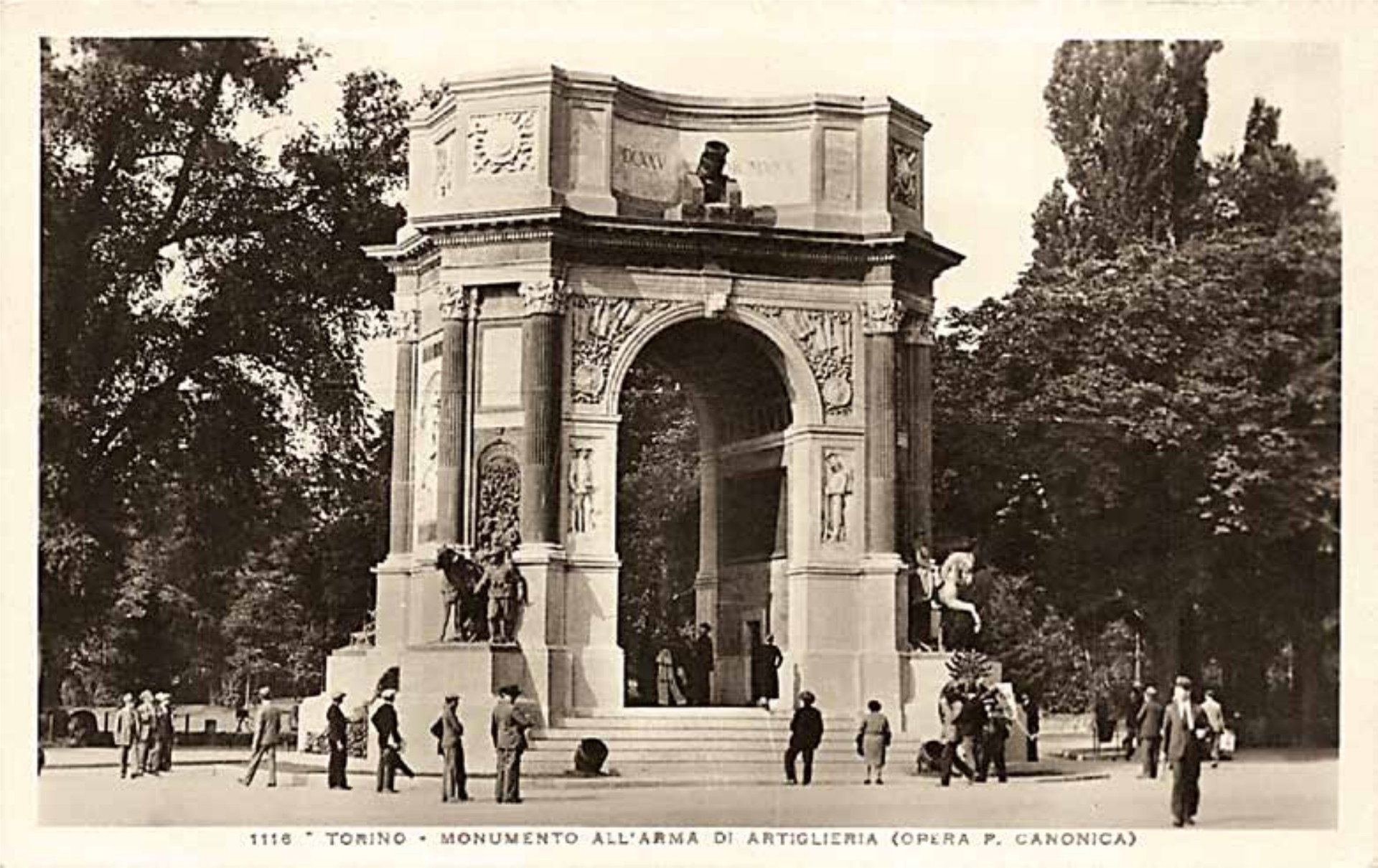
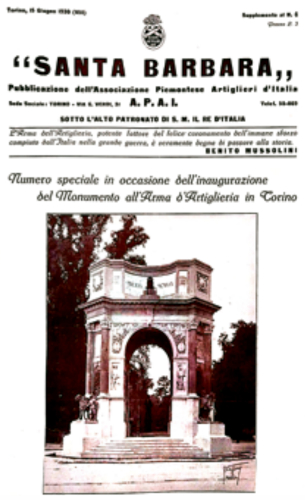
On 15 June 1900 (the Artillery Corps anniversary, 12 years after the beginning of the Solstice Battle), the King and Queen of Italy unveiled the Monument to the Artillery Corps in Turin.
The ceremony was also attended by the Prince of Piedmont, the Duke of Aosta – who, together with his wife, granted the high patronage to the erection of the monument – and the Ministry of War, Pietro Gazzera (old film footage of the celebration is available on YouTube, https://www.youtube.com/watch?reload=9&v=nKY6nLMLX3c).
Some concise reports on the Monument history are available on the Internet; however, these do not account for the many challenges that the promoters had to face. No such report has been released so far to piece up the initiative in detail. On the other hand, 215 typewritten/handwritten documents, financial accounts, postcards, posters, and telegrams (over 500 sheets in total) are kept in the archive of the National Italian Artillery Association. Such documents have never been published and cover a span ranging from 17th November 1923 to 28th June 1928 [1]. These papers give evidence of the long and troubled activity of the organizing Committee to implement the project. The FIRST STEPS were taken on the evening of May 29, 1923: Col. Carlo Montù gathered in his own home in Turin, Via Po 39, with about 30 Artillery officers – both on duty and discharged – to discuss his project for a monument to their Corps, to be necessarily erected in Turin, the cradle of Artillery. At the same time, they also conceived the idea of writing a history of the Italian Artillery; this activity was carried out simultaneously with the work for the erection of the monument. Three Commissions were created in Rome, Milan, and Turin Under the supervision of Ten. Gen. Giacinto Sachero [2], each in charge of specific topics. Such Commissions should have relied on the collaboration by the Historical Department of the General Staff, a promise [3] which was apparently never kept – as witnessed by the papers filed. A Central Executive Committee was then established and the project was commissioned to sculptor Pietro Canonica who soon submitted his draft [4].
DESPITE HAVING BEEN UNANIMOUSLY OFFERED THE CHAIRMANSHIP OF THE COMMITTEE, COL. MONTÙ REFUSED AND INSTEAD ACCEPTED TO BE APPOINTED AS SECRETARY-GENERAL, PROVIDED THE CHAIRMAN WAS A “PURE ARTILLERY” GENERAL [5]
[1] As mentioned, the Monument was unveiled on 15 June 1930; therefore, two years of correspondence are missing. The last available document is the letter of greeting following the resignation, dated 28 June 1928, by MajGen of the reserve Alessandro Goria, who had chaired the Executive Committee for the Monument to the Artillery in Turin since its establishment on 29 May 1923. Gen. Giuria, Artillery Inspector, succeeded him. It is conceivable that most of the correspondence preserved was handed to A.N.Art.I. by one of the first Committee members, perhaps Gen. Goria himself. This hypothesis could be supported by the fact that the correspondence appears chronologically complete and consistent, interrupted only by the resignation letter of the General. Gen. Goria should have kept all the most relevant papers. In his resignation letter of 22 May 1928 to the Chairman of the National Committee, Gen. Dallolio, he mentioned some “very important documents – which I have kept jealously and safe – ….”; this also seems to be confirmed by a handwritten note of the Officer on a letter dated 30 September 1927 “To be returned.” For the remaining part, the papers were probably kept by Gen. Montù, which can also be confirmed by the several handwritten corrections and annotations in red – very often – and blue, using a pencil or a pen; also, many letters look like a draft, then signed with red pencil.
[2] He held the post until his death in June 1925. Gen. De Antonio will succeed him.
[3] By a letter dated 17 October 1923 signed by the Chief of the General Staff, Giuseppe Francesco Ferrari.
[4] Montù saw a wax model in the sculptor’s studio on 13 November.
[5] Letter dated 28 June 1928 by Gen. Goria, as quoted.
Alessandro Goria, MajGen of the reserve, was thus appointed as the Chairman of the Central Executive Committee.
The National Committee had already been established under the high patronage of the Duke and Duchess of Aosta. Such Committee was of a high symbolic significance as – besides being a Gunner – the Duke of Aosta had been the Commander of the 3rd Army Unit, known as “the Unbeaten,” as they had never been defeated. Fourteen regional Committees were thus established in the ten headquarters of the Artillery Army Corps [6], in Genoa, Cagliari, Pesaro, and Aquila [7]. Further ones were being stablished locally [8]; such Committees worked alongside the Honor Board and the National Dames Committee under the high patronage of the Queen Mother. The rules for the setup and management of the Regional Committees were also issued. In the following few months, 50,000.00 It. Liras were raised – equivalent to approximately 46,000.00 Euros [9].
The estimated expenditure amounted to about 1,000,000.00 Italian Liras (927,000.00 Euros). Nonetheless, the “issues of the payment for bronze [10] and the casting costs” were still pending.” Mons. Bartolomasi – the first Bishop of the Military Ordinariate – together with many Italian parish priests and military chaplains who served in the former conflict, spared no effort to involve the entrepreneurs.
[6] Bari, Bologna, Rome, Milan, Naples, Turin, Palermo, Florence, Trieste, and Verona.
[7] The Royal Decree 1891 of 23 November 1939 changed the city’s name to L’Aquila.
[8] Report of the Executive Committee dated 17 November 1923, typescript signed with notes in the left margin. The same report also mentioned that the Regional Committee from Lazio “chaired by Gen. Bennati and Ten. Pasquali, lawyer, is at the same time the center of the new Association SANTA BARBARA that aims to bring together in one Body all the Italian Artillery”. Col. Montù wrote to Gen. Bennati on 21 June 1923. His letter was aimed at reassuring the General about the actual purpose of the Executive Committee which was to bring glory to the Artillery Corps. As the Colonel stated, the intent was not to “intrude upon other people’s work, specifically the programmatic one by this National Association.” Montù added that his idea was ” to establish in Turin a regional or local branch of the Association, which could have benefited from the Executive Committee organization. The request was accepted. Gen. Bennati later received a letter stating that “the Turin branch can be considered constituted.” A copy of such a letter – with the usual notes in red pencils commonly used by Montù – was then attached to an undated circular letter forwarded in June 1923”.
[9] An anonymous bombardier donated 1,000.00 Liras, accompanied by the following words: “I’d rather consider this a duty to our Mother than a sacrifice”. Handwritten letter from Col. Montù to Gen. Goria dated 10 June 1923.
[10] Canonica estimated an amount of about 25 tons and informed Gen. Dallolio on 8 August. On 11 September 23, Montù told him that the Ministry of War would provide the 25 tons of bronze requested; however, the Ministry of Finance required the material to be paid 125,000.00 Liras. Montù asked his superior to intercede with the Minister of War and possibly also with the Prime Minister not only because the bronze was offered free of charge but also because the casting would have been carried out in a military plant.
THE FIRST DIFFICULTIES
1924 started with a meeting urgently summoned by Col. Montù, following the accusation of having wasted the money raised. The agenda was meant to clarify that the Committee had no intention to abandon the project and all the money raised had been adequately invested [11]. In such a meeting the financial Advisor submitted the balance sheet for 1923, which was however never found. On 10 May, all the financial concerns seemed to have been cleared, and the Committee members – except Col. Montù who was travelling to Rome – were received by the Duke of Aosta. On such an occasion, the speech by Gen. Goria highlighted the effort by Col. Montù as the original promoter of the initiative. On 29 May – the first anniversary of the Central Executive Committee – a meeting was held with the Presidents of the historical Commissions and the Regional Committees. One of the items on their agenda was also the general financial situation and the budgets of each regional Committee. The general financial frame had probably raised some concern. In fact, on 15 June Montù wrote to Goria to inform him that: “However, I am pleased to inform you that I have finally received the payment of one thousand Liras from the Regional Committee of Lombardy for the advertising materials…As you may see, my prophecies are being fulfilled. The Committee of Lombardy still owes us over four thousand Liras for the advertising materials, only……. In a few days, I will forward a note to all the Regional Committees to spur them to action.”
A few days later, Montù wrote back again to the President, who blamed him for not having attended the meeting planned at the request of Montù himself. Montù complained about the lack of understanding by General Goria as to his current situation: his father had recently died and he was engaged with the bureaucracy connected with the inheritance procedures – apparently problematic – and at the same time with the disease of both his wife and his daughter.
Gen. Goria had urged the meeting through his daughter, and the answer received by the Secretary probably seemed inappropriate; this is why he then answered: “there has definitely been a misunderstanding, and loyal gentlemen of our rank shall clarify it.” The letter from Gen. Goria is handwritten, while the answer by Col. Montù is typed; both are hand-signed.
As of November 1924, the Committee performs a further attempt to urge the Committees to take action as “SO FAR, THE FUND RISING HAS FRANKLY ACHIEVED POOR RESULTS.”
By the end of the year, the funds raised amounted to 152,355.17 Liras (approx. 141,000.00 Euros); as costs amounted to 29,952.55 Liras (27,777.00 Euros), the positive balance was 122,402.62 Liras (113,517.00 Euros).
[11] Montù expressed his “justified personal resentment” and asked “to shed light” on his work. Other misunderstandings and disagreements will occur in the following years.
TO CUT EXPENDITURES OR TO INTERRUPT THE FUND-RAISING?
The situation remained unchanged with the new year. The Chairman of the Executive Committee suggested a further meeting to discuss cutting expenditures. Montù (as stated in his letter dated 6 March 1925) strongly disagreed as such a decision would substantiate “the unfounded claims and hostile critics we faced.” A further topic for discussion was whether to interrupt the fun-rising to focus instead on publishing the History of the Artillery Corps (as from a letter dated 10 March from Col. Montù to Gen. Goria). In the meeting on 17 March, the Executive Committee decided to carry on with the project by cancelling all administrative expenditures [12], and restarting the campaign among the entrepreneurs. Meanwhile, further 7,851.00 Liras were raised. The Regional Committees were thus invited to intensify the fund-raising by organizing parties and events. The target to be achieved for the erection of the Monument and the publishing of the History of the Artillery Corps was thus set to 1,200,000.00 Liras.
[12] It is worth saying that the Committee never obtained any reduction or special rates for postal expenses – as insistently requested but never accepted. Until March 1925, it also paid rent for the office, which was later transferred to the headquarters of the Academy of Artillery and Engineering from April.
A new agreement was achieved with sculptor Canonica (dated 16 April 1925) in the wake of such decisions. Briefly, the Committee accepted the project submitted in November of the previous year, except for an equestrian group of statues that had to me removed. The total amount to be paid for the work was 1,000,000 Liras. The agreement clearly stated that no further expenditure would be admitted or refunded. A sum of 100,000.00 Liras was immediately made available to the sculptor, and the same amount will have been paid to him in 1926. The contract also included an explicit clause by which the artist was entitled to no further claim if the 1,000,000.00 Liras amount agreed [13] would not have been paid in full (probably because the Committee had never shelved this plan). The artist initially seemed reluctant to sign the contract, perhaps because the Committee disagreed with the changes he submitted. One of the letters by Montù clearly states: “.. all this proves that we must firmly stand to our decision without accepting any of the changes submitted,” highlighting the sentence in red. On 30 April, Canonica finally signed the agreement, and on 1 July, an evidently relieved Montù will write the following: “I will not be in Turin in the next days. However, there is nothing urgent to be discussed; everything seems almost set” [14]. In fact, on 27 July Canonica will ask for the initial amount of 100,000.00 Liras to be paid.
Montù resigned on 28 December, as previously advanced in his 19 December letter. He stated that such a decision was due to health and family reasons and his intention to follow his interests. However, he also said his decision would have become “effective and irrevocable” in January. Again, this was an occasion for a misunderstanding with Gen. Goria, who considered the resignation a personal offense.
[13] The agreement is not signed; however, the original paper includes a draft receipt to be filled by Canonica as an attachment. The latter was presumably issued at a later date for the 1926 payment; in fact, the paper refers to the agreement dated 5 April 1926.
[14] Letter signed with a red pencil by Gen. Goria.
A SURGE RESTART AND THE BEGINNING OF WORKS
1927 started with Montù’s resignation, which he confirmed by a letter dated 2 February. A handwritten note by Gen. Goria on such a letter state: “in a meeting with Gen. Sasso [the Commander of the Artillery and Engineering Corps Academy] on 11-II-927, he withdrew his resignation, calling the shots from Bellagio [where Montù owned a house and retired] and exchanging letters here with Col. Count Giuseppe Balbo [i.e., Col. Giuseppe Balbo di Vinadio who collaborated with Montù from February 1927, when the resignation became effective].”
An agreement was finally found, and probably welcomed by Montù himself as he took care of organizing a meeting with his replacement officer to whom he delivered all the documents in his hands together with the “box” [15] on 22 February. Montù also promptly informed Gen. Goria, occasionally calling him by his first name at the request of his superior but soon going back to using his last name. Montù maintained his position as a Secretary-General, and Balbo di Vinadio was appointed as a bursar. Meanwhile, the fund-raising carried on, as shown by the yearly financial statement dated 12 February 1927. The funds raised amounted to 663,462.13 Liras (slightly more than 552,000.00 Euros); the total expenditures were 419,646.95 Liras, 350,000.00 of which were “advanced payments to sculptor Canonica and miscellaneous expenses for the bureaucratic procedures.” Finally, the Municipality of Turin authorized the building works at the Valentino Park, at the intersection of Corso Cairoli and Corso Vittorio Emanuele II. The digging works for the foundations started in August. Col. Balbo visited the site on 7 of the same month together with sculptor Canonica, who promised that the erection works would have started before the winter. Canonica asked for a further payment of 150,000.00 Liras, which he still did not receive in October, thus threatening to disrupt the works and terminate the contract (as the amount was due according to the terms of the agreement signed in 1926). Balbo di Vinadio sent a few telegrams and wrote a letter to Gen. Goria asking to authorize the payment. In August, he also requested Montù, who believed that “the best solution is to take as much time as possible and pay as late as possible” [16]. The amount due was certainly paid, but no receipt has ever been found [17]. According to the balance sheet of the fund-raising, the amount collected by 15 November 1927 was 710,134.24 Liras (equivalent to about 600,000.00 Euros), 569,646.95 Liras of which have to be deducted for the payments made (500,000.00 Liras were paid to the sculptor). In his last letter to Gen. Dallolio dated 1927, Gen. Goria states his intention to resign. He pointed out that he would have already left had it not been for the insistence by Montù aimed at avoiding the inevitable crisis following the resignation of the Secretary-General and Chairman of the Executive Committee.
In 1928 the letter exchange was poor and included the following papers: the minutes of the Executive Committee meetings held on 23 April and 12 May, two letters from Gen. Dallolio to Gen. Goria (the first of which was handwritten on the headed paper of Royal Senate dated 10 May, and the second typewritten as of 13 June), two typewritten letters from Gen. Goria (one dated 22 May to answer Gen. Dallolio writing on 19, and the other when he left on 25 June), and the balance sheet dated 25 June 1928. Regarding the two Committee meetings, it may be worth pointing out the resolution made on 23 April not to pay any additional money to Canonica. According to the agreement clauses, he was entitled to receive the amount of 150,000.00 Liras. The reason which led to withholding the payment was “an unjustified delay of the works” [18]; also, the sculptor should have been reminded of his engagements both amiably – via Col. Vaciago, a friend of his and a member of the Committee- and officially – via the Podestà. At the same meeting, Gen. Goria announced having submitted to Gen. Dallolio his resignation without ever receiving an answer and – he added – “provided H.E. had received my letter”; such a letter is not included in the papers at our hands. Gen. Dallolio answered on 19 May, asking Goria to remain in office until he comes to Turin with the future Chairman of the Executive Committee, the Artillery Corps Inspector Gen. Giuria. In the following meeting it was suggested to formally warn the sculptor; a contribution by the Municipality of Turin was also announced to be paid in 1929. The last paper, as already mentioned, was Gen. Goria’s farewell letter. According to the balance sheet of 25 June 1928. 755,798.69 Liras were raised, equivalent to 682,685.00 Euros. A footnote handwritten by Gen. Goria on the paper stated: “For the Central Executive Committee meeting of 25 June 1928 – from H.E. Gen. Dallolio Alberto for the assignment of the new Chairman of the Committee, H.E. LtGen Ettore Giuria replacing the outgoing Chairman MajGen Alessandro Goria”. The words definitely revealed his sadness but also the moral certainty of having successfully carried out his job for five years and sealed the papers kept in the archive of the National Italian Artillery Association.
[15] Two passbooks from the bank Cassa di Risparmio di Torino and two policies relating to the nine-year bonds kept by the bank administration department.
[16] Typed letter dated 16 August. The sentence quoted was written in red.
[17] This is a further element to support the assumption that the documentation preserved in the A.N.Art.I.’s archive comes from Gen. Goria and Gen. Montù. When Col. Balbo di Vinadio was appointed, the letters preserved were almost exclusively signed by Gen. Goria or addressed to him; in fact, all the drafts and the circular letters are missing, which Montù instead used to keep.
[18] The sculptor was then engaged in crafting impressive commemorative monuments of Kemal Ataturk, still existing in Ankara, Istanbul, and Smyrna. His activity often brought him to Turkey, inevitably delaying his work in Italy.
THE MONUMENT
From each of the four corners, a bronze group depicting one of the specialized units of the Corps is projecting, i.e., field artillery, mountain artillery, support artillery, and bombardiers. The Monument is enriched with allegorical figures: Air and Fire are located on the two sides, while Chemistry and Technique are framed within two large medallions. The coats of arms of Rome – the cradle of Risorgimento – and Turin – the Italian Artillery’s soul – are located on the two façades. On the top. a seventeenth-century bombard was placed. An altar was built under the arch with the statue of Saint Barbara. The Corps’ history is engraved on the columns.
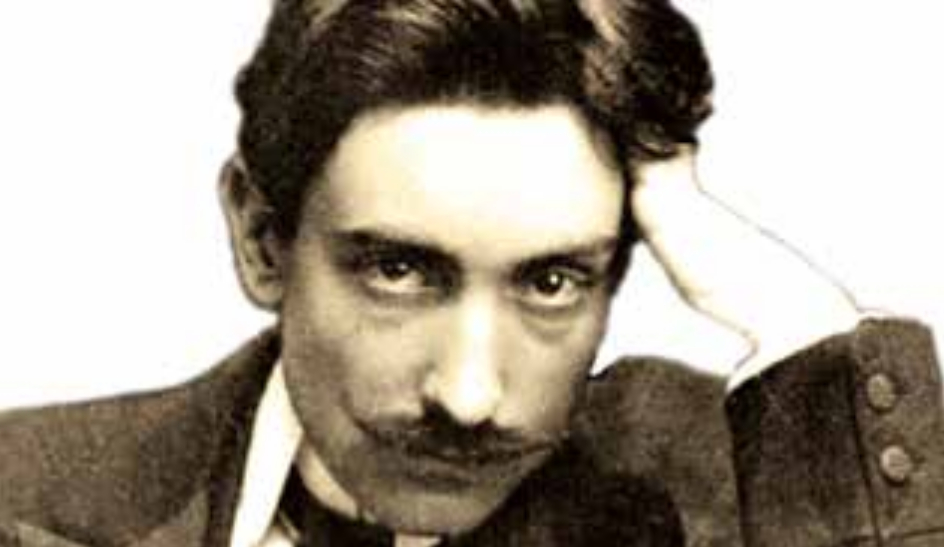
Pietro Canonica was born in Moncalieri, Turin on March 1, 1869. After attending the Albertina Academy in the Piedmontese capital, he opened his atelier in 1889 and received his first commission after revealing remarkable skills and careful execution. The work consisted of four plaster statues for the church of S. Lorenzo di Villanova Mondovì. In the early 1900s, he obtained commissions in Russia, where he carved monuments for Tsar Alexander II and Grand Duke Nicholas. In the late 1930s, he worked in Turkey, Iraq, Argentina, and Egypt. He sculpted the funeral monuments of the Popes Benedict XV and Pius XI. Besides the Monument to the Artillery Corps, Canonica also carved in Turin the statue of the Horseback Soldier. His works include the sculpture of the Alpine Soldier in Courmayer and Biella. On 1 December 1950, he was appointed Senator for life and died in Rome on 8 June 1959. He was also a painter and musician. From 1926 he lived in Rome, where he obtained from the Municipality the use of a building that today houses the Canonica Museum. The bronze-lined plaster model of the field artillery group is kept in Room III of the Museum.
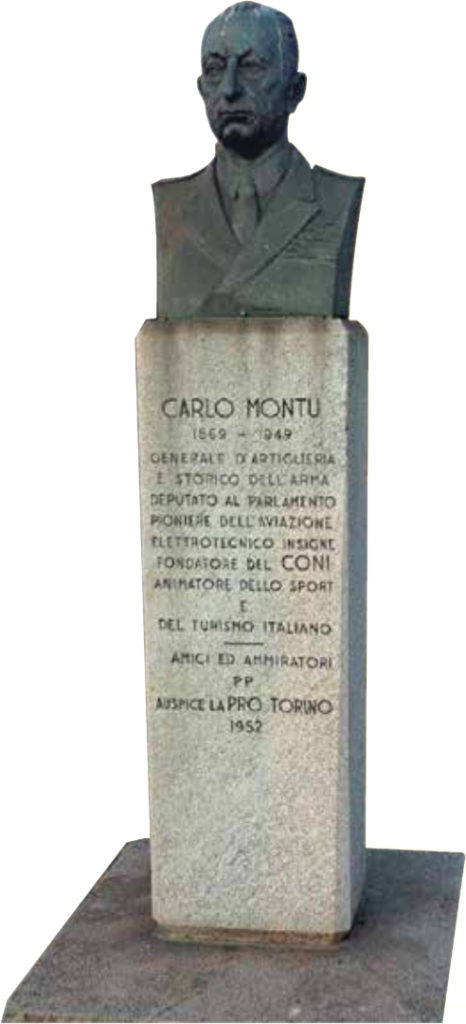
Gen. Carlo Montù was born in Turin on 10 January 1869. When he was 17, he was admitted to the Royal Academy of Turin and left with the rank of Second Lieutenant of Artillery in March 1889. He was assigned first to the School of Artillery and Engineering Applied Studies and, the following year, to the 11th artillery regiment. In 1893 he retired and transitioned into the reserve. He earned a degree in electrical engineering and later became a university professor in Turin and Naples. From 1909 to 1913, he was Deputy of the Kingdom; in 1911, he was recalled to service with the rank of an Artillery Captain and fought in Libya, where he was deployed in the Special Observers Group. Wounded during a flight – and the first aviator shot down by land forces – he was decorated with the Silver Medal of Military Valor and returned to Italy. He was recalled to service again at the outbreak of the First World War in 1916. He took command of the 30th field artillery regiment and later deployed to France. When he returned to Italy, he became the 45th field artillery regiment commander. He earned four Military Valor decorations during the war – two Silver Medals and two Bronze Medals. In World War II, he was recalled with the rank of Major General and served in the War Office. His volcanic personality also led him to the top positions in several national sports: he was the president of the Italian Football Federation – the CONI, which awarded him the title of Pioneer of football in 1949. He was also a president of the Italian Fencing Federation, Commissioner of the CONI – of which he proposed the creation -and president of the National Rowing Federation. He died in Bellagio on 19 October 1919. He is the author of the monumental History of Italian artillery.